New York City Rental Guide · Neighborhood History
Green-Wood Cemetery, A Living Masterpiece
From the desk of Jason Mezydlo · @JasonMezydlo
Jason Mezydlo · Managing Sales Partner, Gordon Realty Partners
347.286.5797 · jason@gordonrealtypartners.com · JasonMezydlo.com
622 3rd Avenue, New York, NY
When I moved to South Slope in 2014, I felt a little lost. My first years in Brooklyn had been spent up north. I lived in Fort Greene, and my world revolved around Fort Greene and Clinton Hill, with nights out at Williamsburg loft parties and Chelsea gallery openings across the river. South Slope wasn’t a neighborhood I knew. I came for a very practical reason: I found a great deal on a cute apartment with a huge backyard, the kind of outdoor space that makes a New Yorker stop and do the math twice.
It wasn’t long before I wandered a few blocks south and found myself standing in front of the great brownstone gates of Green-Wood Cemetery. I walked in, and I’ve been walking in ever since. Green-Wood is the reason South Slope became home. It’s where I go to think, to slow down, to watch the seasons turn, and to remember how lucky I am to live next door to one of the most beautiful places in New York.
A Garden for the Dead, and the Living
To understand Green-Wood, picture Brooklyn in the 1830s. The City of Brooklyn had only been incorporated in 1834, and the hills above Gowanus Creek where the cemetery now sits were pasture and woodland owned by old farming families like the Bennets, Bergens and Wyckoffs. Across the river, Manhattan had a burial crisis. Churchyards were overcrowded, and fears of yellow fever and contaminated wells had led the city to ban new burials below Canal Street in 1823.
A young Brooklynite named Henry Evelyn Pierrepont had an idea, inspired by Boston’s Mount Auburn Cemetery, which had opened in 1831 and launched the “rural cemetery” movement: build a burial ground outside the crowded city, designed like an English landscape garden. Green-Wood was incorporated on April 18, 1838, and the engineer David Bates Douglass laid out its grounds.
The Victorians saw death differently than we do. Nature, once considered wild and threatening, had come to stand for goodness and peace, and death was approached as something gentle and beautiful. Douglass designed Green-Wood to match that sensibility. Instead of a grid, he followed the land, sending drives and footpaths curving through hills, valleys and ponds left behind by the last glacier, and framing views of the harbor and the city. The idea was to wander, reflect and feel the sublime.
New Yorkers loved it. By 1860, about 500,000 people a year were visiting, making Green-Wood one of the country’s biggest tourist attractions, second only to Niagara Falls. Families came for Sunday picnics and carriage rides. Its popularity helped inspire the public parks movement, including Central Park and, a few blocks from my apartment, Prospect Park.
Gothic Gates and Little Stone Houses
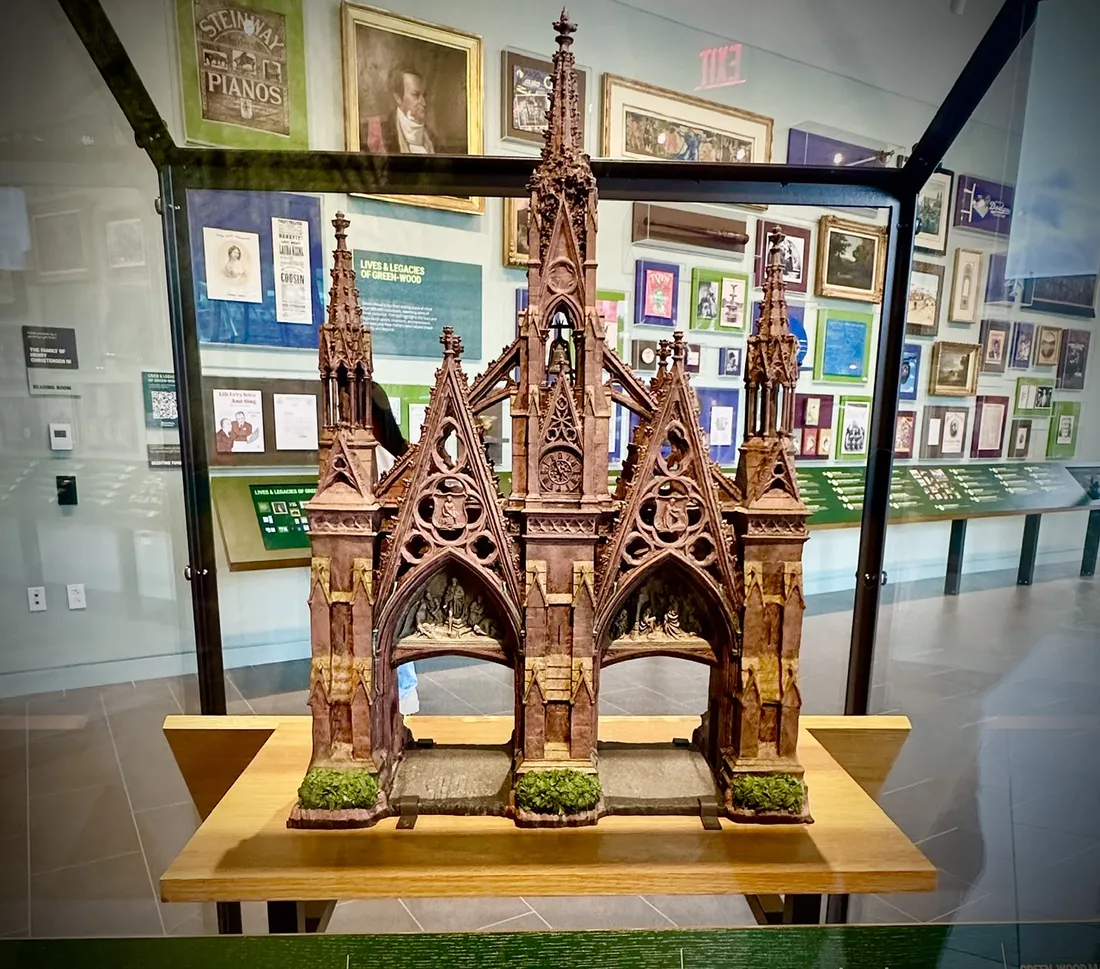
The main entrance at Fifth Avenue and 25th Street is one of my favorite buildings in the city. Designed by Richard Upjohn and his son, Richard M. Upjohn, in 1861, the gate is a soaring piece of Gothic Revival architecture in Belleville brownstone, the same warm stone you see on the rowhouses of Park Slope. (Upjohn also designed Trinity Church on Wall Street.) Look closely at the gateways and you’ll find carved scenes from the Bible by sculptor John Moffitt.
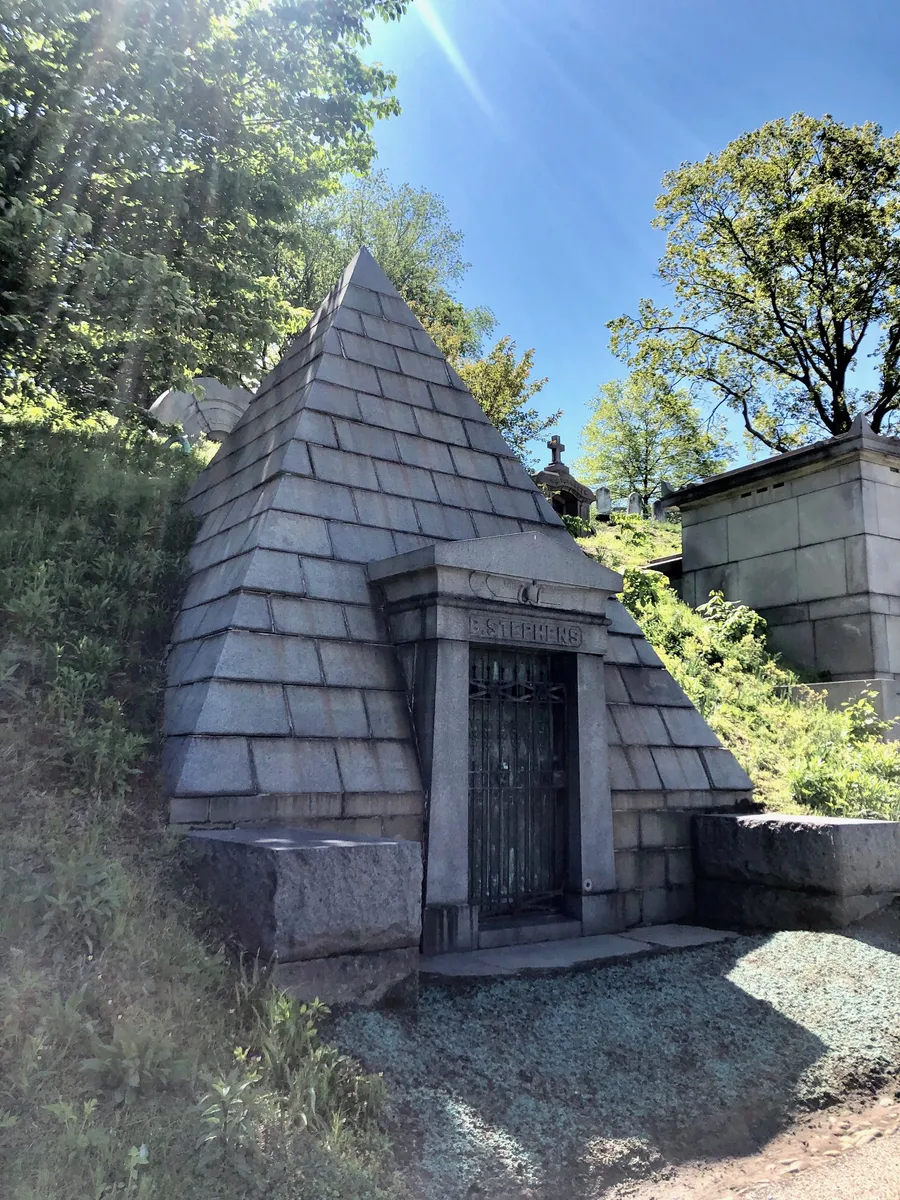
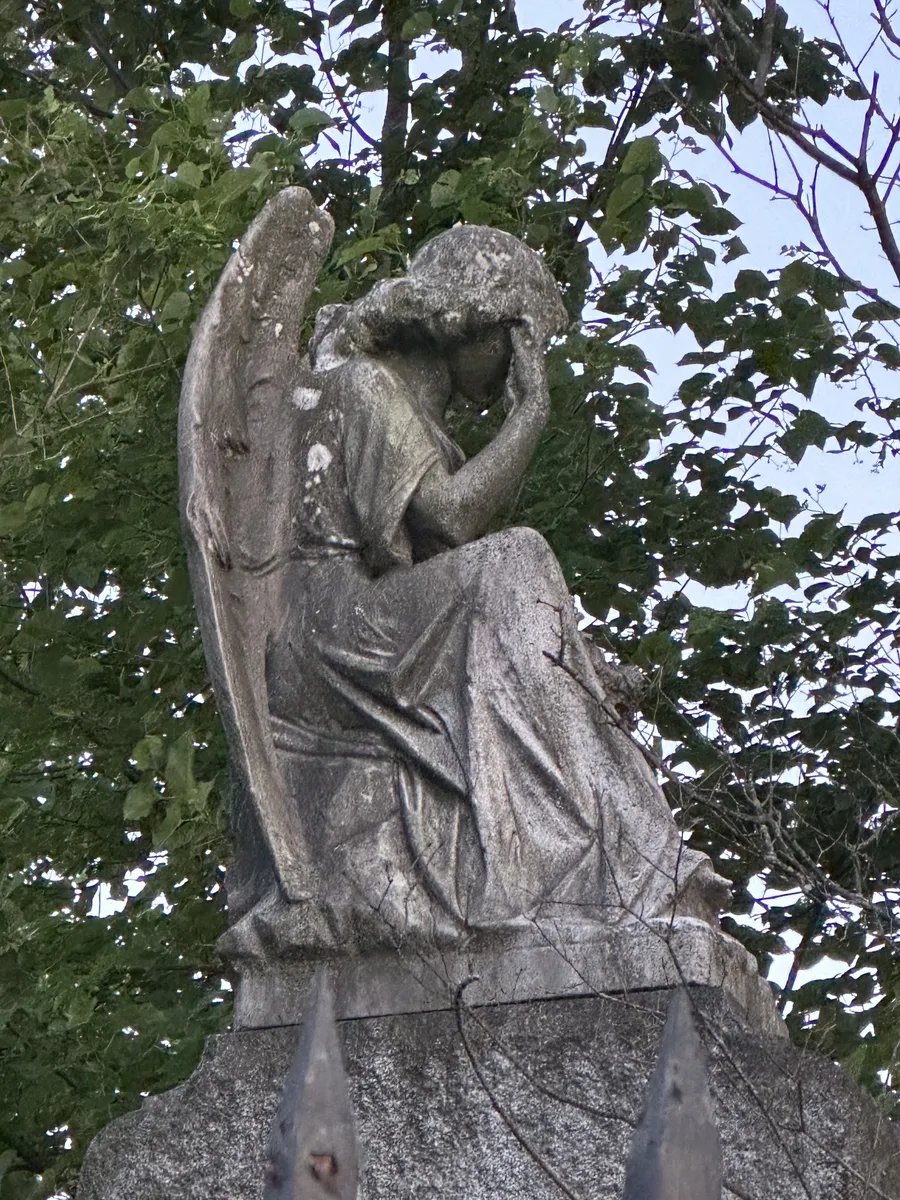
Inside, Green-Wood is a museum of 19th-century architecture in miniature. There are more than 800 mausoleums, and walking past them is like touring every revival style the Victorians loved: Classical temples with columns, small brownstone tombs that are among the oldest on the grounds, pointed Gothic Revival chapels, and Egyptian Revival tombs, including the Van Ness–Parsons pyramid guarded by a sphinx. Some monuments are by the great American sculptors of the era, including Daniel Chester French and Augustus Saint-Gaudens.
Wild in the City
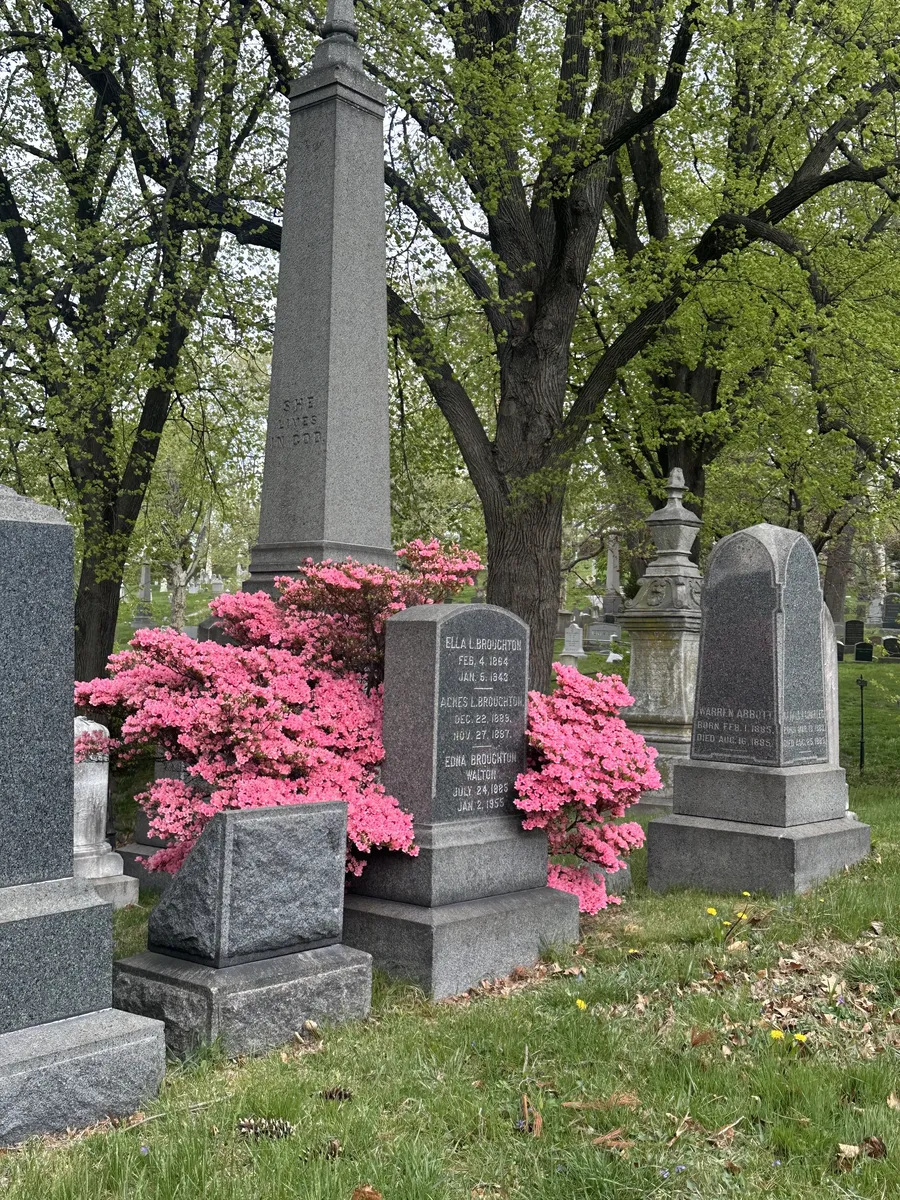
What surprised me most is how wild Green-Wood feels. Its 478 acres are a working arboretum, one of the most important in New York, with about 8,000 trees representing 695 species and varieties. There are towering red and black oaks, tulip trees, European beeches, black gum, a Himalayan pine and a state champion sassafras, the oldest and largest of its kind in New York State. In spring, the cherry trees and magnolias stop me in my tracks. In fall, the whole place turns copper and gold.
The water is just as special. The cemetery’s ponds were formed by glaciers, and Sylvan Water, with its little island, is a true kettle pond. Turtles sun themselves along the edges, and if you’re lucky you’ll catch a heron fishing in the shallows. Green-Wood sits on the Atlantic Flyway, so in spring and fall it fills with migrating birds, and birders come from all over the city.
The animals have become my neighbors. Over the years I’ve seen skunks, possums and more raccoons than I can count, and lately even little lizards darting across the paths (most likely Italian wall lizards, which arrived on Long Island in the 1960s and have been spreading west ever since). One afternoon, just down the block, a hawk perched in a street tree and calmly ate a rat while a small crowd of us stood on the sidewalk and gawked. Only in Brooklyn.

Over 570,000 Permanent Residents
Green-Wood is home to more than 570,000 permanent residents, and the list reads like a history of New York. Composer Leonard Bernstein is here. So are painter Jean-Michel Basquiat, stained-glass master Louis Comfort Tiffany, newspaper editor Horace Greeley, abolitionist preacher Henry Ward Beecher, “Boss” Tweed of Tammany Hall, Brooklyn Dodgers owner Charles Ebbets, baseball pioneer Henry Chadwick, and Dr. Susan Smith McKinney-Steward, New York State’s first Black woman physician, who was born in Brooklyn’s Weeksville. More than 5,000 Civil War veterans rest here, too.
Minerva, My Grandmother and the Best View in Brooklyn
When my grandmother came to visit me from Arizona, I wanted to show her my Green-Wood, so we took the trolley tour. I thought I knew the place pretty well by then, but our guide filled every turn with stories, and I came away with a whole new appreciation for it. That was the day I first saw Minerva.
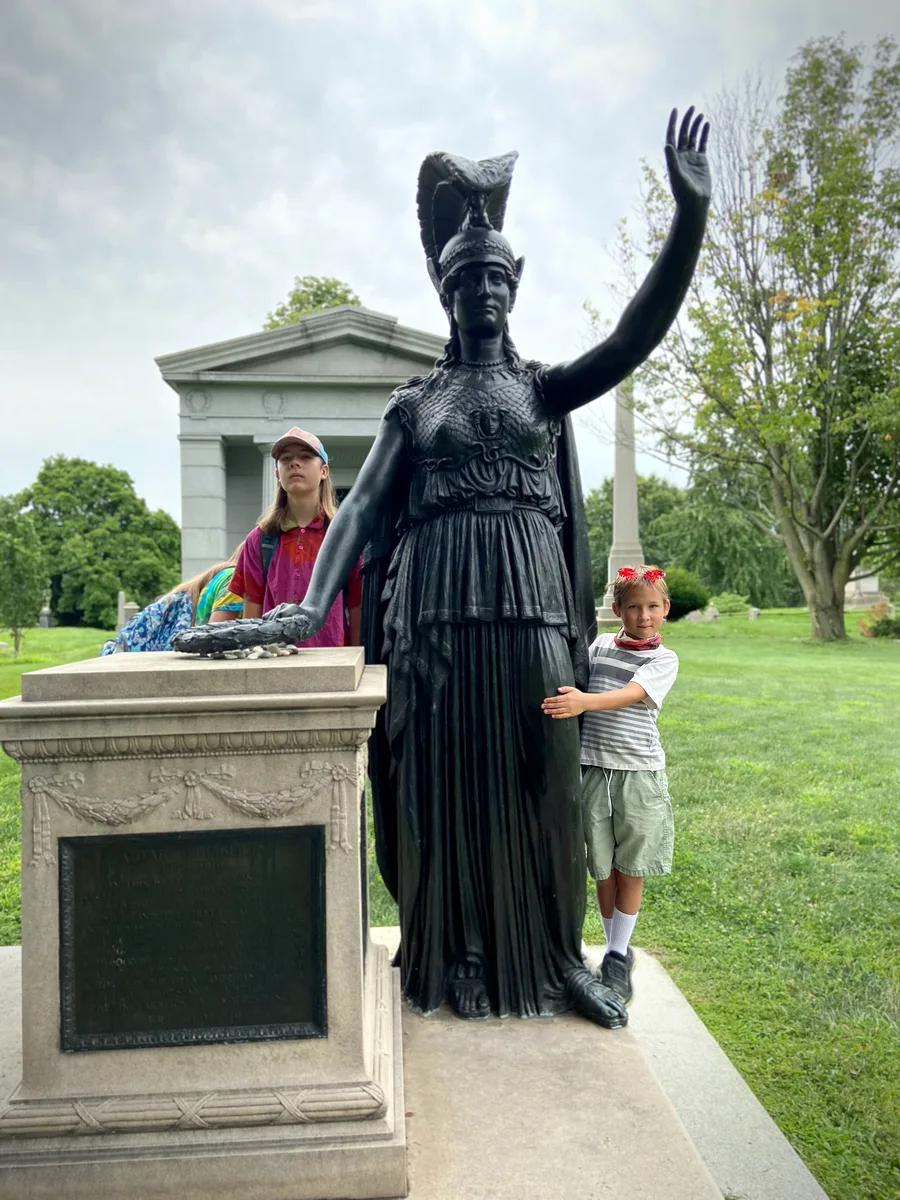
She stands on Battle Hill, the highest natural point in Brooklyn at about 216 feet. On August 27, 1776, American soldiers fought British troops on these slopes during the Battle of Brooklyn, the first major battle of the Revolutionary War after the Declaration of Independence. In 1920, ink manufacturer Charles Higgins, who felt the battle had been all but forgotten, dedicated the Altar to Liberty, with a bronze Minerva, goddess of wisdom and war, by the sculptor Frederick Ruckstull. Her raised arm salutes the Statue of Liberty across the harbor, and the two ladies have been greeting each other ever since. Neighbors have fought to protect that view from new development.
Standing next to her with my grandmother, looking out over the water to the Statue of Liberty and the Manhattan skyline, is one of my favorite memories. Go on a clear evening if you can. It’s worth the climb.
Green-Wood Today
What I love most is that Green-Wood isn’t frozen in time. It’s more alive now than ever.
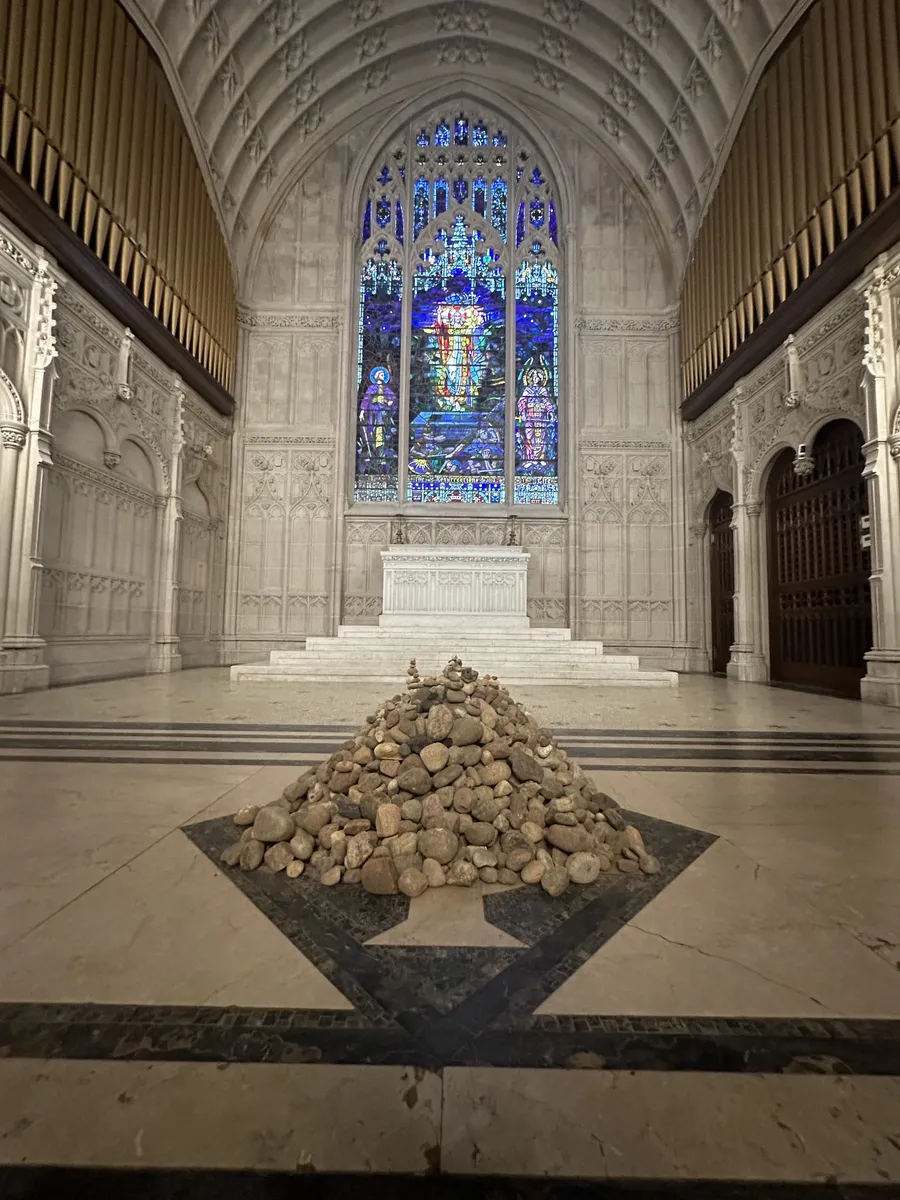
Jean Shin’s Offering. In the meadow facing the main gate, artist Jean Shin buried trees that spent their whole lives at Green-Wood, including a red oak and a pin oak that had to come down because of damage. They lie in a trench more than 100 feet long beneath a gently sloping mound, planted by volunteers with wildflowers and shrubs. As the wood slowly decays, it will feed the soil and the new life growing above it. Shin was inspired by burial mounds, especially the rounded mounds of traditional Korean funerary practice. She has said she wanted the trees honored “as part of our lineage,” and that the piece imagines “that death is not the ending, but really just the beginning.” I can’t think of a better place for it.
The parrots are still here. Look up at the spires of the main gate and you’ll hear them before you see them: bright green monk parakeets, natives of Argentina, chattering away in their enormous stick nests. Nobody knows exactly how they got here (the most famous story involves a broken crate at JFK in the late 1960s), but they’ve called the gate home for more than half a century, built like little apartment buildings with separate entrances for each pair. True New Yorkers.
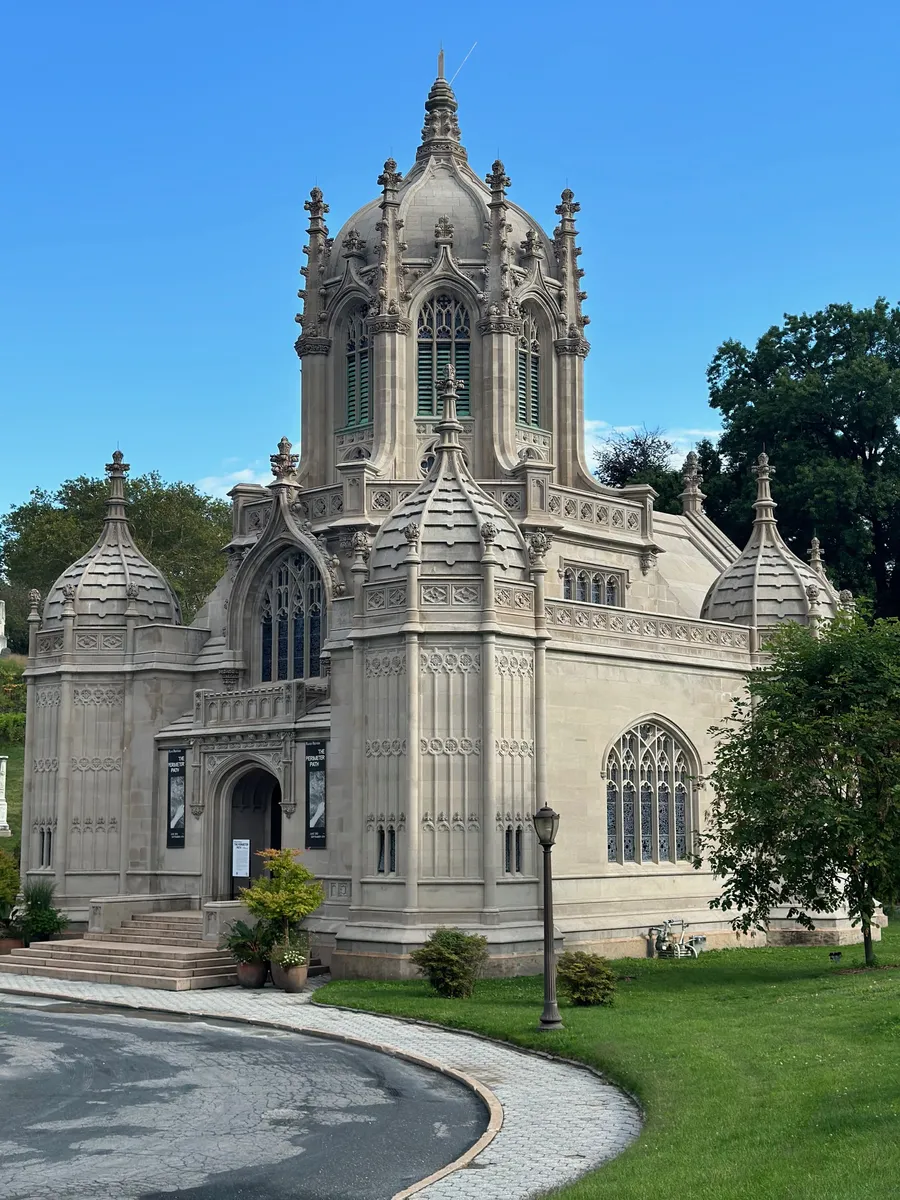
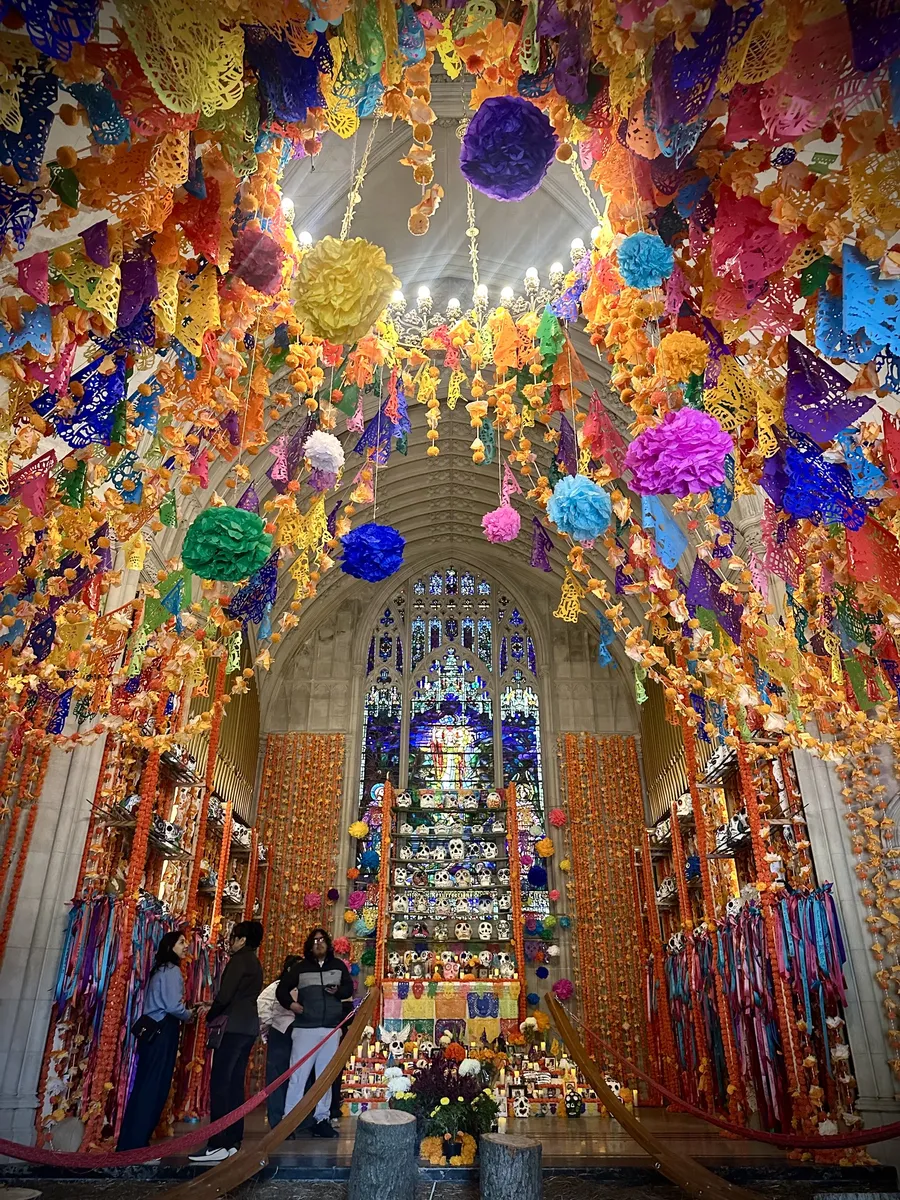
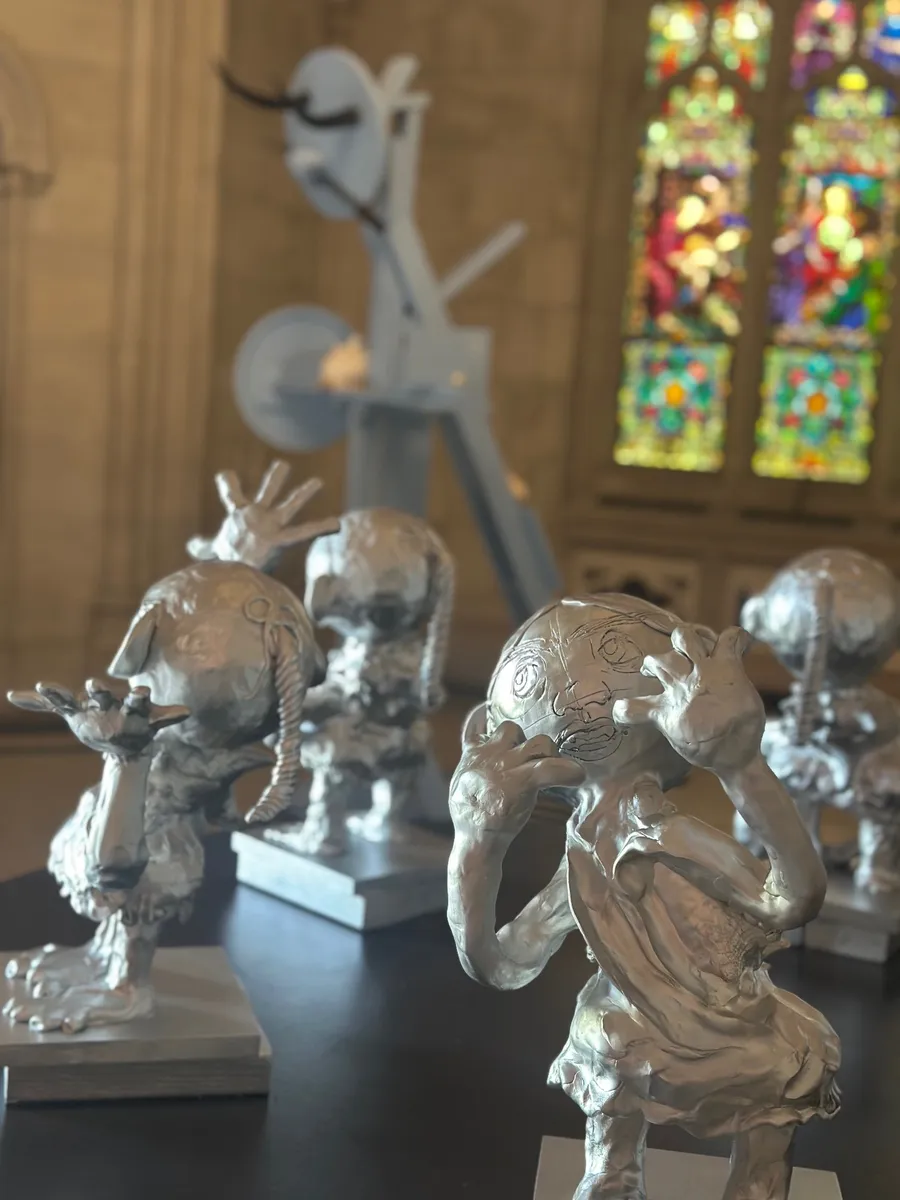
The Chapel. Near the main gate stands the cemetery’s chapel, completed in 1911 by Warren & Wetmore, the architects of Grand Central Terminal. Built as a non-denominational place for funerals and services, it’s a small Gothic gem modeled on Christopher Wren’s Tom Tower at Christ Church, Oxford, crowned with a dome and filled with stained glass. These days it doubles as an exhibition space. Right now it holds Laura Anderson Barbata’s Reposo y Recuerdo (Rest and Remember), a Day of the Dead installation where you can rest in handwoven hammocks under paper marigolds and papel picado, surrounded by nearly 200 papier-mâché calaveras made by artists in Chihuahua, Mexico, and members of our own Brooklyn community. You can write a memory on a ribbon or leave a tribute on the community altar. It’s on view daily through November 15.
The Green-House. Across Fifth Avenue from the gate, the old Weir Greenhouse, one of the last Victorian greenhouses left in New York City, dating to 1895, has been reborn. The new Green-House at Green-Wood, designed by Architecture Research Office with a green roof by Michael Van Valkenburgh Associates, wraps the restored glass greenhouse in a new terra-cotta building. It opened this past April, on the cemetery’s 188th birthday, and it’s free: maps, an exhibition gallery with records going back to the 1838 founding, a wall of notable residents with their grave locations, a research center for tracking down ancestors, and classrooms for kids and adults. Jean Shin’s companion gallery piece, Celadon Landscape, is on view there through January 2027.
Coming Up at Green-Wood
Nightfall: Thursday, Oct. 22 & Friday, Oct. 23, 7–10:30 p.m. Green-Wood after dark, along a brand-new route. $70 general admission, $56 for members, $95 premium. Buy tickets · Event details Discover Green-Wood Trolley Tour: Saturday, Oct. 24, 1–3 p.m. The same kind of tour I took with my grandmother. Book early. Buy tickets · Event details The Revolution Continues: Brooklyn’s Black Trailblazers: Saturday, Oct. 24, 10 a.m.–noon, a free trolley tour including Jean-Michel Basquiat’s grave. Reserve a spot · Event details Grave Beginnings: Green-Wood by Trolley: select Sundays at 11 a.m., including Oct. 25, Nov. 8 and Nov. 22. A free, hour-long introduction to the cemetery. Reserve a spot · Event details Day of the Dead Family Celebration: Monday, Nov. 2, 4–7 p.m. Free, with music, performances and crafts. Registration is recommended, with a suggested $10 donation. Register · Event details The Green-House: open Thursday through Monday, 10 a.m.–7 p.m., always free. Visit the Green-House Full calendar & tickets: green-wood.com/calendar · Instagram @historicgreenwood · Main entrance: 500 25th Street, Brooklyn
More than a decade after I wandered in feeling a little lost, Green-Wood is still the first place I take visiting friends and family, and the place I go when I need to remember why I love living here. If you’re thinking about South Slope, Greenwood Heights, Windsor Terrace or Park Slope, there’s nothing quite like having 478 acres of history and nature just down the block.
Find Your Own Green-Wood
Every neighborhood has a place like this, the one that makes it feel like home. Mine happens to have 478 acres, a hilltop goddess and a colony of parrots. If you’re thinking about South Slope, Greenwood Heights, Windsor Terrace or Park Slope, I’d love to show you around, from the blocks that border the cemetery to the apartments where you can see the trees from your window.
Reach out to me at 347.286.5797, jason@gordonrealtypartners.com, or JasonMezydlo.com, and follow along on Instagram at @JasonMezydlo for more of my favorite corners of Brooklyn.
Event dates, hours and exhibition details come from Green-Wood and can change. Check green-wood.com before you go.
Sources
- The Green-Wood Cemetery, The Cultural Landscape Foundation
- Green-Wood Cemetery, City Lore: Place Matters
- Green-Wood Cemetery’s Act of Incorporation, 1838, Green-Wood Historic Fund
Show all 19 sourcesShow fewer
- Hidden Gems: Green-Wood Cemetery, Baruch College, CUNY
- Green-Wood Cemetery: Entrance, Michael Minn
- Green-Wood Cemetery’s tombs as miniature houses, Domus (June 2026)
- The 5 Weirdest Tombs and Mausoleums at Green-Wood Cemetery, Untapped New York
- The Living Collection, The Green-Wood Cemetery
- Green-Wood Cemetery Podwalk, Brooklyn College
- Lizards of New York City, 10,000 Birds
- Notable Residents, The Green-Wood Cemetery
- Battle Hill (Brooklyn), Wikipedia
- Minerva: Facing What?, Green-Wood Historic Fund
- Jean Shin’s Living Memorial to the Trees of Green-Wood Cemetery, Hyperallergic (April 2026)
- The Monk Parrots of Green-Wood Cemetery, Untapped New York
- Building of the Day: Chapel in Green-Wood Cemetery, Brownstoner
- Reposo y Recuerdo press release, The Green-Wood Cemetery (October 2026)
- Green-Wood Cemetery opens new welcome center that surrounds Victorian greenhouse, 6sqft (April 2026)
- Events Calendar, The Green-Wood Cemetery
About Jason Mezydlo

Jason Mezydlo is Managing Sales Partner at Gordon Realty Partners and has worked in New York City real estate since 2012. A graduate of the Harrington College of Design with a BFA in interior design, he brings a designer’s eye to every search, helping clients see what a space can become before they sign. Jason began his career in commercial leasing, guiding small business owners through site selection, lease negotiation and space planning, before moving into Manhattan’s luxury rental market and home sales across Manhattan and Brooklyn. A longtime Brooklyn resident, he pairs market expertise with a deep love for the city’s history, art and architecture.
347.286.5797 · jason@gordonrealtypartners.com · JasonMezydlo.com · @JasonMezydlo
Gordon Realty Partners · 622 3rd Avenue, New York, NY · NYS Licensed Real Estate Salesperson